Gypsum board manufacturing is a demanding, high-volume process where speed, accuracy, and reliability are essential. From standard drywall and moisture-resistant panels to fire-rated and specialty drywall products, manufacturers must ensure that every board is properly identified, traceable, and compliant with applicable product and industry requirements.
Choosing the right printer to mark gypsum boardr is an important part of achieving those goals.
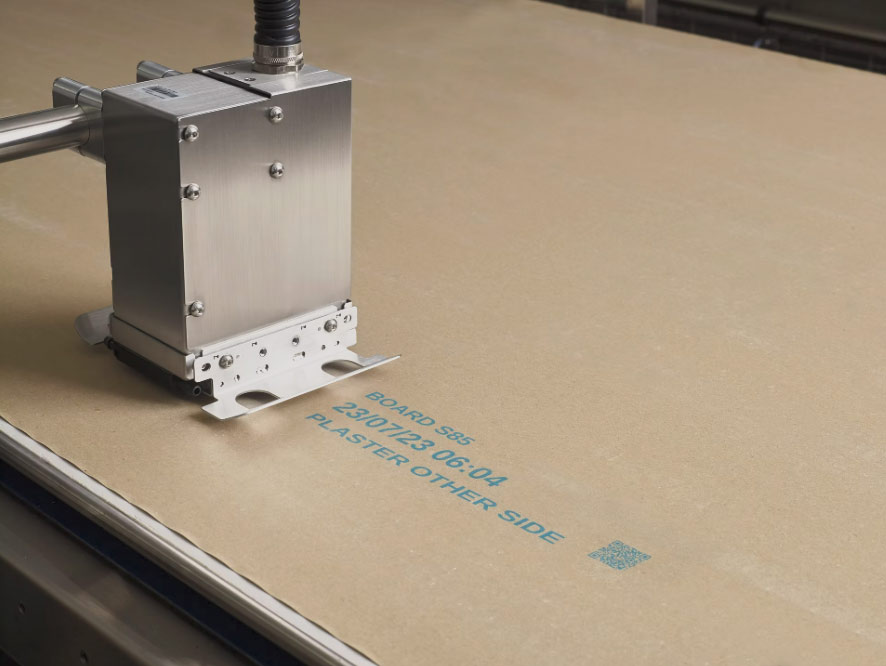
Industrial inkjet printing technologies allow manufacturers to apply product identification, production dates, batch numbers, logos, and other critical information directly onto gypsum boards as they move through the production line. However, not all inkjet systems deliver the same results.
Two commonly considered technologies are Drop-on-Demand (DOD) inkjet printing and high-resolution inkjet printing. Both can provide effective solutions for gypsum board marking, but each offers distinct advantages depending on production conditions, marking requirements, and the desired level of print quality.
Understanding these differences is essential when selecting a gypsum board printer that supports operational efficiency, consistent marking, and long-term reliability.
Why Gypsum Board Printing Matters
Gypsum boards are widely used in residential, commercial, and industrial construction. Their manufacturing process typically involves forming a gypsum core between facing materials, cutting the continuous board into sections, drying the panels, and preparing them for finishing, stacking, and shipment.
Throughout this process, manufacturers need a reliable way to identify products and communicate essential information.
Common gypsum board printing applications include:
- Manufacturer names, logos, and product identification
- Production dates, times, and batch numbers
- Board dimensions, thicknesses, and product specifications
- Fire-resistance or moisture-resistance designations
- Quality control and traceability information
- Applicable certification or compliance markings
- Machine-readable codes for automated tracking
Depending on the production environment, this information may be printed on the board’s face, back, or edge.
Each location introduces different challenges. The paper facing may have variable absorbency, while board edges can be rough, porous, and susceptible to dust accumulation. Production lines also operate at substantial speeds, leaving little room for printing interruptions.
The right gypsum marking technology can handle those conditions and can still deliver a clear, scannable mark on each board.
Understanding DOD Inkjet Printing for Gypsum Boards
Drop-on-Demand (DOD) inkjet technology is widely used for industrial marking applications, particularly those involving large characters, porous materials, and challenging production environments.
Unlike continuous inkjet systems, DOD printers generate droplets when required to form the desired characters, symbols, or graphics.
In industrial large-character DOD systems, printheads typically use a defined arrangement of nozzles to create text and codes as products move past the printing station.
Advantages of DOD Inkjet Printing
- Reliable Large-Character Marking
DOD technology is particularly effective when manufacturers need bold, highly visible characters.
For gypsum board production, this can include product names, batch identification, dimensions, and other information that must remain legible during handling, storage, and transportation.
- Suitability for Porous Surfaces
Many industrial DOD systems are designed to print on porous materials, making them well suited for applications involving paper-faced gypsum boards and other absorbent building products.
Proper ink selection allows the marking system to produce readable codes while accommodating variations in surface characteristics.
- Industrial Durability
Gypsum board manufacturing environments can expose printing equipment to airborne dust, vibration, and continuous production demands.
Industrial DOD systems designed for these conditions can provide dependable performance when equipped with appropriate printhead protection, cleaning procedures, and maintenance practices.
- Cost-Effective Product Identification
For manufacturers primarily printing straightforward alphanumeric information, DOD systems can offer an economical approach to large-character marking without requiring the capabilities of a higher-resolution printing platform.
Limitations of DOD Printing
Traditional large-character DOD systems may not provide the fine detail required for complex graphics, small text, or high-density machine-readable codes.
Print quality also depends on nozzle configuration, printhead distance, ink characteristics, and production speed.
For applications requiring detailed logos or compact information within a limited print area, high-resolution inkjet technology may be the more appropriate solution.
Understanding High-Resolution Inkjet Printing
High-resolution inkjet technology is designed to produce sharper characters, detailed graphics, and more complex printed information.
Although high-resolution industrial inkjet systems may also use drop-on-demand principles, the term generally describes printing platforms capable of producing finer image detail than conventional large-character DOD systems.
These systems can be particularly valuable when manufacturers need to print extensive product information, precise graphics, or machine-readable codes.
Advantages of High-Resolution Inkjet Printing
- Superior Print Detail
High-resolution systems can produce smaller characters, cleaner edges, and more detailed images than many conventional large-character DOD printers.
This capability is valuable when gypsum board manufacturers want to include product specifications, branding elements, or multiple lines of information within a relatively compact area.
- Enhanced Branding Opportunities
Manufacturers increasingly recognize the value of consistent product identification throughout the supply chain.
A high-resolution inkjet printer for gypsum board can support more sophisticated logos, product names, and graphics, helping manufacturers maintain a recognizable brand presentation.
- Machine-Readable Coding
When supported by the selected printer, ink, and substrate combination, high-resolution printing can be useful for applying barcodes and 2D codes.
These codes may support inventory management, production tracking, warehouse operations, and traceability programs.
However, successful code scanning requires more than nominal printer resolution. Print contrast, substrate texture, code size, and verification standards must also be considered.
- Flexible Printing Content
High-resolution systems can accommodate applications involving multiple text fields, variable data, and more complex print layouts.
This flexibility is useful for manufacturers producing different board types, sizes, or specifications on shared production lines.
Limitations of High-Resolution Printing
High-resolution systems are not automatically the best option for every gypsum board application.
Some printing technologies require more controlled printhead-to-surface distances, careful substrate preparation, or additional protection from dust and debris.
Highly porous or irregular surfaces may also affect fine-detail reproduction.
Furthermore, advanced printing capabilities can introduce additional equipment, consumable, or maintenance considerations that may not be justified for simple product identification requirements.
DOD vs. High-Resolution Inkjet: Key Differences
Selecting the appropriate drywall printer begins with understanding how the technologies compare across common manufacturing requirements.
| Consideration | Large-Character DOD Inkjet | High-Resolution Inkjet |
| Primary application | Bold text and large-character identification | Detailed text, graphics, and complex codes |
| Print quality | Optimized for legible, larger markings | Finer detail and smaller characters |
| Porous surfaces | Often well suited with compatible inks | Suitable with proper system and ink selection |
| Dusty environments | Industrial configurations available | May require additional protection |
| Logos and graphics | Basic graphics, depending on system | More detailed branding capabilities |
| Barcodes and 2D codes | Limited by resolution and configuration | Better suited to detailed codes when validated |
| Equipment costs | Often economical for basic marking | Varies with system sophistication |
| Maintenance | Depends on ink, printhead, and operating conditions | Depends on technology and environmental protection |
| Best fit | Straightforward, highly visible marking | Complex, detailed, or variable-content printing |
Neither technology is universally superior. The best choice depends on the specific requirements of the production line.
Six Factors to Consider When Choosing a Gypsum Board Printer
1. Surface Characteristics
Gypsum boards present several potential printing surfaces, each with unique properties.
Paper-faced surfaces are generally more uniform than exposed gypsum edges, but absorbency, coatings, and surface treatments can still affect ink performance.
Exposed edges may be rough, dusty, or inconsistent, making fine-detail printing more difficult.
For large identification marks on porous or irregular surfaces, industrial DOD technology may offer practical advantages.
For detailed printing on relatively consistent paper-facing materials, high-resolution inkjet may be more appropriate.
In either case, manufacturers should conduct printing tests using actual production materials.
2. Production Line Speed
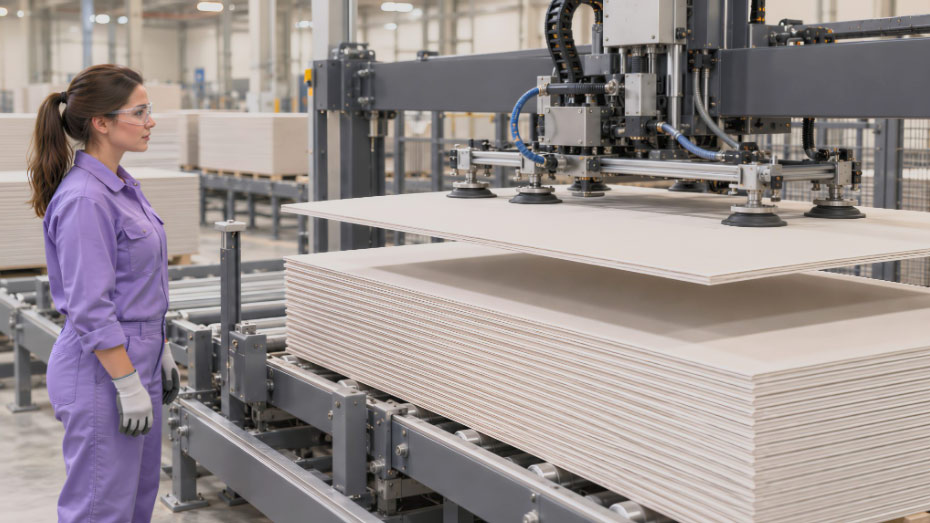
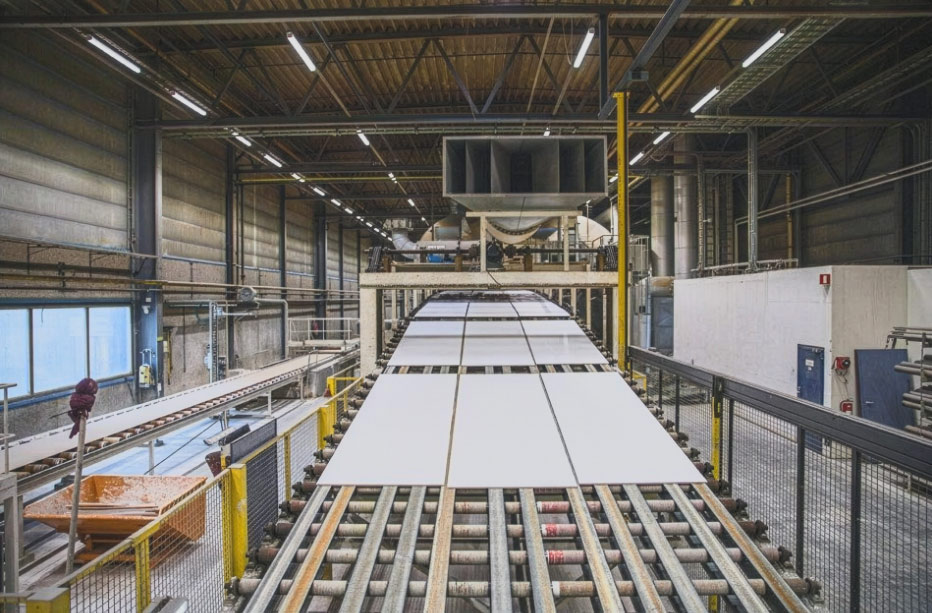
Gypsum board manufacturing often involves continuous, high-speed production.
A printing system must apply the required information without creating bottlenecks or requiring frequent line stoppages.
Both DOD and high-resolution inkjet systems can support industrial production speeds, but actual performance depends on factors such as print height, resolution, ink delivery, and the amount of information being printed.
Manufacturers should evaluate printing performance at their maximum operating speed rather than relying solely on published specifications.
3. Required Print Content
The information printed on each board strongly influences technology selection.
If the application involves a product designation, production date, and batch number in large characters, a conventional DOD printer may provide everything required.
If the manufacturer needs detailed logos, multiple lines of smaller text, or machine-readable codes, high-resolution printing may offer greater flexibility.
The objective should be to match the printer’s capabilities to the actual information requirements rather than investing in unnecessary functionality.
4. Environmental Conditions
Gypsum board production facilities can be challenging environments for printing equipment.
Dust accumulation, vibration, temperature fluctuations, and continuous operation can affect printing performance.
When evaluating a gypsum board printer, consider:
- Printhead protection against dust and debris
- Ease of cleaning and routine maintenance
- Resistance to vibration and mechanical stress
- Accessibility for operators and maintenance personnel
- Compatibility with existing production equipment
Equipment designed specifically for industrial building materials applications is generally preferable to systems intended for cleaner packaging environments.
5. Ink Selection and Drying Performance
Ink formulation is just as important as printer technology.
A successful gypsum board printing application requires ink that provides sufficient contrast, adhesion, and drying performance on the intended surface.
Manufacturers should consider whether the ink must withstand abrasion, stacking, handling, storage, or exposure to moisture.
Ink compatibility with the substrate, printhead, and operating environment should be confirmed through testing.
The appropriate ink will depend on the board’s facing material, surface condition, and the durability requirements of the finished mark.
6. Total Cost of Ownership
The purchase price of a drywall printer represents only one component of its overall cost.
Manufacturers should also evaluate ink consumption, maintenance requirements, replacement parts, operator involvement, and potential production downtime.
A lower-cost printer may become expensive if it requires frequent cleaning or produces inconsistent markings.
Conversely, a more advanced printing system may not provide a worthwhile return if its additional capabilities are rarely used.
The best investment is the system that consistently meets production requirements at an acceptable lifetime operating cost.
How Gypsum Board Printing Supports Traceability and Quality Control
Product traceability has become an increasingly important consideration across building materials manufacturing.
Accurate identification helps manufacturers connect finished boards with production information, quality control records, and distribution activity.
A properly integrated inkjet printer for gypsum board can apply variable data directly onto each product or production batch.
This information may include manufacturing dates, production line identifiers, shift codes, and batch numbers.
When connected to plant control systems, printing equipment can also help automate data changes and reduce the risk of manual coding errors.
For manufacturers implementing more advanced traceability programs, high-resolution printing may support machine-readable codes that connect physical products with digital records.
However, the level of coding sophistication should reflect actual operational needs.
Large-character DOD printing remains a practical solution for manufacturers whose traceability processes rely primarily on human-readable identification.
When Is DOD the Better Choice?
Large-character DOD technology is often a strong choice when manufacturers need durable, highly visible identification on porous building materials.
It is particularly appropriate when:
- Print content consists primarily of large alphanumeric characters.
- Boards have rough or variable printing surfaces.
- Fine graphics and compact codes are unnecessary.
- Equipment must operate in dusty industrial conditions.
- Straightforward operation and maintenance are priorities.
For many conventional gypsum board identification applications, DOD technology can deliver the required performance without unnecessary complexity.
When Is High-Resolution Inkjet the Better Choice?
High-resolution inkjet technology is worth considering when print quality, information density, and flexibility are central requirements.
It may be the preferred option when:
- Product markings include detailed logos or graphics.
- Multiple lines of smaller text are required.
- Barcodes or 2D codes are part of the traceability strategy.
- Product variations require frequent content changes.
- The printing surface and operating conditions support finer-detail marking.
High-resolution systems can also provide opportunities to consolidate multiple identification elements into a single printing operation.
The suitability of any particular system should be confirmed through application testing.
Why Work With REA JET for Gypsum Board Marking?
Selecting a printing technology is only the beginning. Successful implementation requires matching the printer, ink, printhead configuration, and production-line integration to the manufacturer’s specific application.
REA JET specializes in industrial coding and marking solutions for demanding manufacturing environments, including building materials production.
Its industrial inkjet portfolio includes large-character DOD and high-resolution printing technologies designed to address different marking requirements.
Rather than approaching every application with the same technology, REA JET helps manufacturers evaluate the factors that determine successful printing performance.
These include substrate characteristics, production speeds, environmental conditions, print content, and maintenance expectations.
Application-specific testing can help identify the most suitable solution before full production implementation.
Choose the Right Plasterboard Printer for Your Production Line
Both DOD and high-resolution inkjet technologies offer important advantages for gypsum board manufacturers.
Large-character DOD systems are particularly attractive for straightforward product identification, while high-resolution printing provides additional capabilities for detailed graphics, smaller text, and advanced coding applications.
The right decision ultimately depends on the information being printed, the surface receiving the mark, and the operating conditions of the manufacturing facility.
REA JET can help you determine which drywall printer best meets your production requirements.
Contact REA JET to discuss your gypsum board printing application and explore an industrial marking solution designed for reliable, consistent performance.
 Or call 440-232-0555
Featured Coding & Marking Technologies View all
Most-requested coding & marking systems.
- 01 Large Character Inkjet Printers (DOD) Direct-to-product marking for cases, pallets, lumber, building materials and other porous surfaces
- 02 High-Resolution Inkjet Printers Print sharp text, logos, barcodes and 2D codes directly on products and packaging
- 03 Laser Systems Permanent, maintenance-free marking for traceability, compliance and product identification
- 04 Barcode Verification Systems Verify barcode quality and readability to meet retailer, GS1 and customer requirements
- 05 Small Character Inkjet Print date, lot, batch and traceability codes for production lines and packaging
- 06 Spray Mark Technology Reliable product identification and defect marking for manufacturing and industrial processes