
In the fast-moving world of consumer goods, good packaging is no longer enough. For modern Consumer Packaged Goods (CPG) companies, the ability to print, mark and track a product through every stage of its life cycle can make the difference between mere shelf presence and true market leadership. For GS1-compliant players and agile consumer packaged goods companies alike, understanding the types of 2D barcodes and how to apply them through effective product-marking solutions is increasingly strategic. Whether you’re a small startup or one of the large global CPG manufacturers, this article outlines why you must act now, how to do it, and what benefits await.
Understanding 2D Barcodes
At the heart of effective product-marking solutions for CPG manufacturers lies the concept of the two-dimensional (2D) barcode. Unlike traditional one-dimensional (1D) linear barcodes—consisting simply of vertical lines and spaces—a 2D barcode encodes data both horizontally and vertically.
Here’s why this matters for CPG businesses:
- Higher data density: A 2D barcode can store thousands of characters, far more than a 1D barcode.
- Smaller footprint: Because 2D codes pack more data in less space, packaging real estate becomes more flexible.
- Built-in error correction: Many 2D symbologies provide error correction, meaning codes may remain readable even with some damage.
For CPG manufacturers, this means you can embed traceability, batch details, serial numbers, routing information or even consumer-engagement links directly on packaging. That transforms your marking from a mere compliance afterthought into a strategic tool.
Why CPG manufacturers particularly need effective product marking
CPG businesses, like any other consumer-industry companies, face large SKU counts, complex supply-chain flows, retailer demands, regulatory scrutiny, and increasingly discerning consumers. As such, effective product marking solutions become a linchpin for:
- Ensuring accurate traceability across global operations
- Enabling anti-counterfeiting measures and authenticity verification
- Supporting consumer engagement (scan codes linking to brand story or loyalty)
- Minimizing packaging waste and maximizing efficiency
In this context, mastering the different types of 2D barcodes becomes essential for CPG suppliers and CPG vendors who wish to differentiate in the modern market.
Exploring Different Types of 2D Barcodes
Let’s delve into the specifics of several prominent 2D barcode formats and what they mean for CPG companies and CPG organizations.
QR Code
The most widely recognized is the 2D barcode. It supports high data capacity, mobile scanning, and is consumer friendly.
In a CPG context, a QR can link from packaging to a brand’s mobile site, consumer instructions, or authenticity check—so CPG manufacturers and CPG vendors can use it to connect product marking with consumer engagement.
DataMatrix / GS1 DataMatrix
Supported by GS1, this symbology is widely adopted in packaging, especially where space is limited or mark durability is required.
For CPG suppliers operating in small-format packaging (cosmetics, single-serve, blister packs), DataMatrix offers a strong solution.
PDF417 and Stacked Codes
These are stacked or layered 2D codes (or grouped 1D codes) such as PDF417, MacroPDF417, etc.
Often used for shipping labels, regulatory marking or where moderate space exists, CPG industry companies can use them for tracking pallets, cases, or regulatory compliance.
Aztec, MaxiCode, Other Advanced Types
Other less common but still relevant symbologies include Aztec, MaxiCode (used by logistics firms), and high-density variants.
For global manufacturers (international CPG organizations) who ship to diverse markets, being aware of logistic codes and regional symbology standard requirements matters.
Summary Table
| Symbology | Ideal Use-Case for CPG Manufacturers |
| QR Code | Consumer engagement, marketing, mobile scan |
| DataMatrix/GS1 DataMatrix | Small packaging, high data density, traceability |
| PDF417 / stacked | Cases, pallets, logistic marking |
| Aztec/MaxiCode | Complex logistics, cross-dock shipping, global compliance |
Understanding these types of 2D barcodes gives CPG players the foundation to design product-marking solutions that align with packaging format, surface, scanning method, and supply-chain requirement.
Enhancing Label Information
Effective product marking isn’t just about selecting a symbology—it’s about what you encode and how you integrate it into the supply and consumer chain.
What kind of information can be embedded
Beyond the typical batch number and expiry date, CPG industry companies can embed:
- Serial numbers (for premium/skus)
- Manufacturing line ID, plant location
- Source or lot of raw material (for transparency)
- Consumer-facing URL or mobile link (for engagement)
- Regulatory information, certifications or tamper-proof info
By using a 2D barcode with sufficient data capacity, CPG manufacturers and CPG vendors can transform packaging into a data-rich asset.
Designing the label for marking
- Packaging space: Small formats may restrict size; choose DataMatrix if minimal area.
- Surface material: Non-porous surfaces (glass, metal) may require durable marks or adhesives.
- Contrast and legibility: Ensure sufficient contrast and quiet zones as per scanner standards.
- Consumer engagement layer: For CPG businesses seeking brand differentiation, link scan-codes to additional content (e.g., “Scan to view batch story”).
Linking supply-chain and consumer-chain
For CPG suppliers, linking the 2D barcode data with internal systems (ERP, MES, traceability) enables streamlined recall, quality control and inventory management. For consumer-industry companies, linking to mobile experiences builds brand value.

Efficient 2D Scanning Techniques
Selecting the correct scanner and integrating scanning workflows is just as crucial as selecting the barcode symbology.
Types of 2D scanners
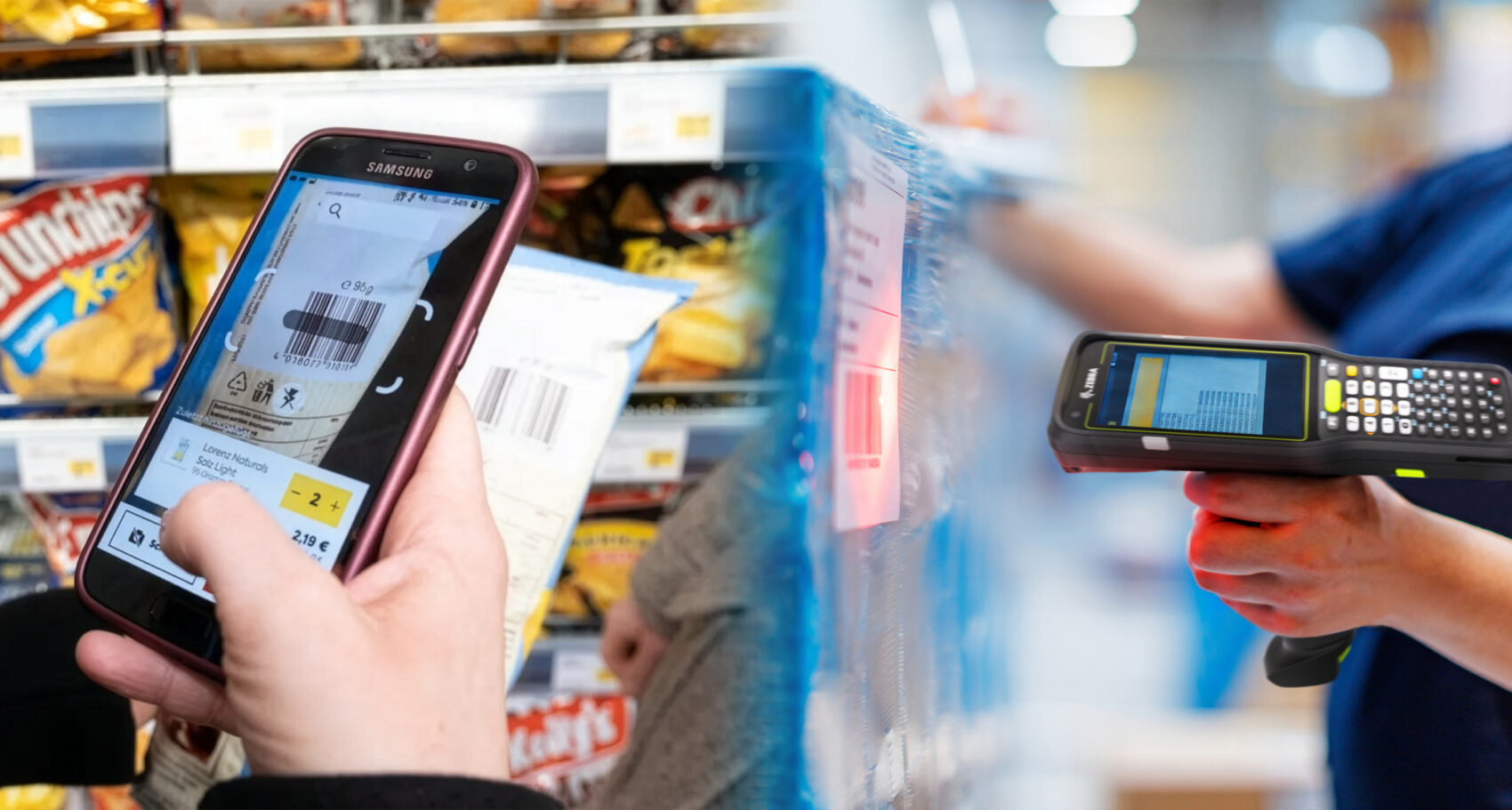
- Area-imager scanners (camera-based) that capture the full 2D pattern. 2D barcodes require imaging rather than traditional laser scanning.
- Fixed-mount readers for production lines (automated marking inspection).
- Mobile devices (smartphones) for consumer or field-based scanning (useful for CPG organizations enabling consumer engagement).
Best practices for scanning in CPG manufacturing
- Ensure proper positioning and lighting: prevent glare, ensure contrast.
- Use vision systems for inline verification of mark quality, readability and presence.
- Logging scan events: capture serial/lot scans, operator ID, timestamp for traceability.
- Integrate with downstream systems: warehouse, shipping, retail scanning should all reference the same code data.
By investing in efficient scanning, CPG manufacturers and CPG industry companies reduce rejects, increase throughput and maintain high data integrity.
Benefits of 2D Scanners
Why should CPG industry companies invest in 2D scanning capability? The benefits are numerous:
a) Enhanced Data Capture
With 2D codes using both axes, scanners capture more data in one scan, reducing errors and manual key-in.
b) Better Traceability & Recall Mitigation
Because more data is embedded, CPG businesses can trace individual units or batches through production, distribution, and retail, enhancing recall precision and brand protection.
c) Consumer Engagement
Mobile scanning of QR or other 2D codes allows consumer-facing brands (CPG vendors) to deliver value beyond the pack—recipes, sustainability information, warranty registration.
d) Space Efficiency
2D codes take less surface space than equivalent 1D codes for the same data. This allows more design flexibility for packaging.
e) Improved Read Reliability
Many 2D codes include error-correction and are more robust in real-world conditions (smearing, damage). This improves scanning success and reduces rejects.
For CPG organizations, these benefits translate to stronger operational control, brand trust, and competitive advantage.
Choosing the Right Scanner
Even the best barcode marking means little without the correct reader in place. For CPG manufacturers and CPG suppliers, here’s how to make the decision:
Key evaluation criteria
- Symbology support: Ensure the scanner supports the exact type of 2D barcode you’re using (QR, DataMatrix, PDF417 etc.).
- Scanning speed & environment: High-speed lines require scanners that can keep up; harsh environments require rugged readers.
- Integration & connectivity: Must support communication with your manufacturing execution systems, warehouse management, or mobile/consumer platforms.
- Auto-focus & wide depth of field: Useful when packaging formats vary or line heights differ.
- Verification capability: Some readers include verification to grade the code quality (helpful to meet standards in regulated markets).
- Mobile vs fixed-mount needs: If your CPG industry company engages consumers (through mobile apps, loyalty programs), mobile device scanning may also be required.
By selecting a scanner aligned with your packaging format, line speed, and supply-chain architecture, your CPG manufacturers or CPG vendors ensure that the data embedded by your marking solution gets captured, used, and leveraged.
Maximizing Label Data
Embedding 2D codes is only part of the story—maximizing the value of that data is where smart CPG-industry companies excel.
Leveraging data for operations
- Link the scanned code to your ERP or SCM system: operator ID, line ID, time stamp, shift.
- Use scan analytics to monitor production yield, reject reasons, code quality failures.
- Trigger automated workflow responses: If a code fails verification, line stops, alert generated.
Leveraging data for marketing & consumers
- Offer consumers the ability to scan their pack and get batch-specific information: origin, ingredients breakdown, sustainability narrative. This enhances brand trust for CPG businesses.
- Use the scan event to enroll consumers into loyalty programs or trigger personalized offers.
- Collect anonymized scan data to understand consumer behavior by region, SKU, batch, etc.
Regulatory & compliance benefit
- Store scan logs for audit trails to meet FDA/EU requirements.
- Improve recall readiness: instead of broad lot recall, you can pinpoint affected units thanks to high-density code data.
Partner & retail integration
- Many large retailers now require higher-granularity traceability. Your 2D marking strategy can serve as a differentiator among CPG players.
- Ensure code data flows through to retail POS, shelf systems, logistics partners.
Continuous improvement
- Monitor scan failures and code readability issues; use feedback to refine packaging design, printer set-up, scanning angles.
- Train operators and quality teams to understand code quality (quiet zones, contrast, lighting).
- Stay ahead of evolving standards: GS1 is working on 2D transition programs for retail.
By treating the 2D code not just as a mark, but as a data-asset, CPG manufacturers and CPG industry companies can turn product marking into a strategic advantage.
Conclusion
In a world where consumers expect transparency and supply chains demand agility, effective product marking solutions are no longer optional for CPG manufacturers. Understanding the types of 2D barcodes, selecting the right symbology, investing in scanning infrastructure, and leveraging the data embedded in every mark sets the stage for operational excellence, brand differentiation, and regulatory readiness.
Whether you’re a large global CPG vendor, a regional CPG supplier, or an emerging consumer-industry company, the ability to embed, read and act on product data gives you a competitive edge. Now is the time for all CPG businesses to elevate their strategy: not just to mark products—but to mark progress.
Contact REA JET to explore how agile coding and marking can unlock your packaging potential.