
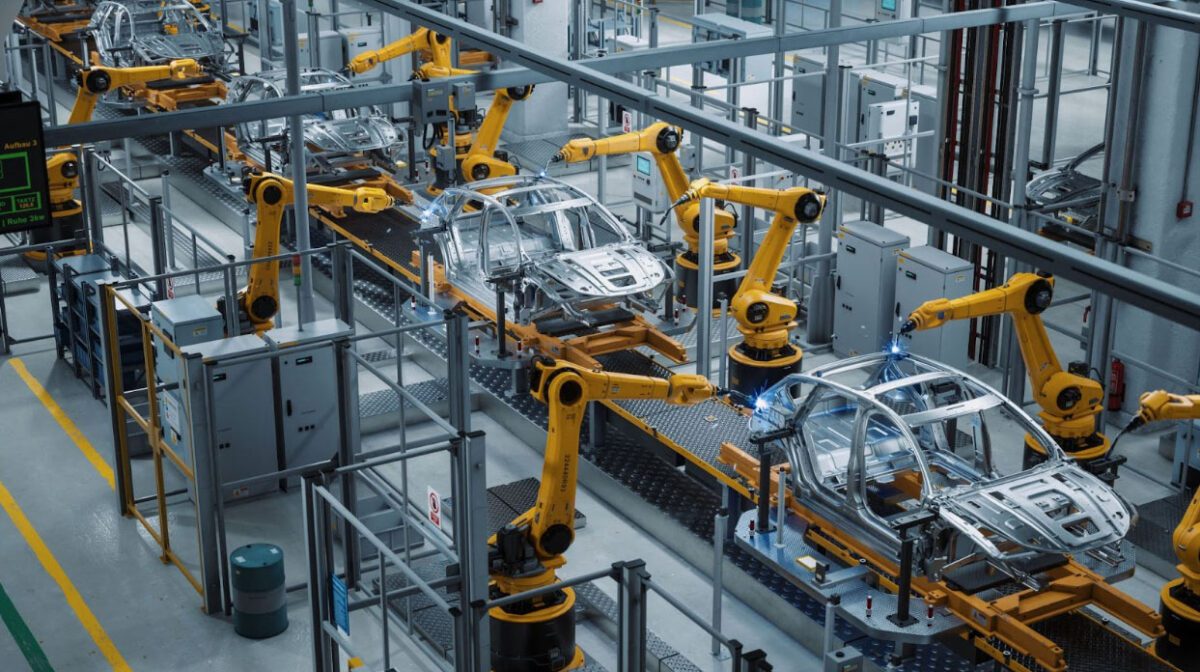
The Importance of Automotive Part Marking
In modern manufacturing, automotive part marking is more than a production formality—it’s a vital component of quality assurance, traceability, and compliance. Each vehicle contains thousands of parts, from critical engine components to interior fasteners, and every one must be identifiable throughout its lifecycle.
By assigning a unique identifier to each part, manufacturers can track components from initial production through assembly, distribution, and even after-sales service. This process enables rapid recalls, counterfeit prevention, and complete traceability within global supply chains.
Automotive part marking ensures that every bolt, piston, and sensor can be linked to production data such as date, batch number, and plant location. This precision data not only supports regulatory requirements but also drives process optimization and accountability across the automotive ecosystem.
Common Methods for Marking Parts
Automotive manufacturers use several different technologies to mark metal, plastic, and composite components. The chosen method depends on the material type, required durability, and environmental conditions the part will face.
a. Dot Peen Marking
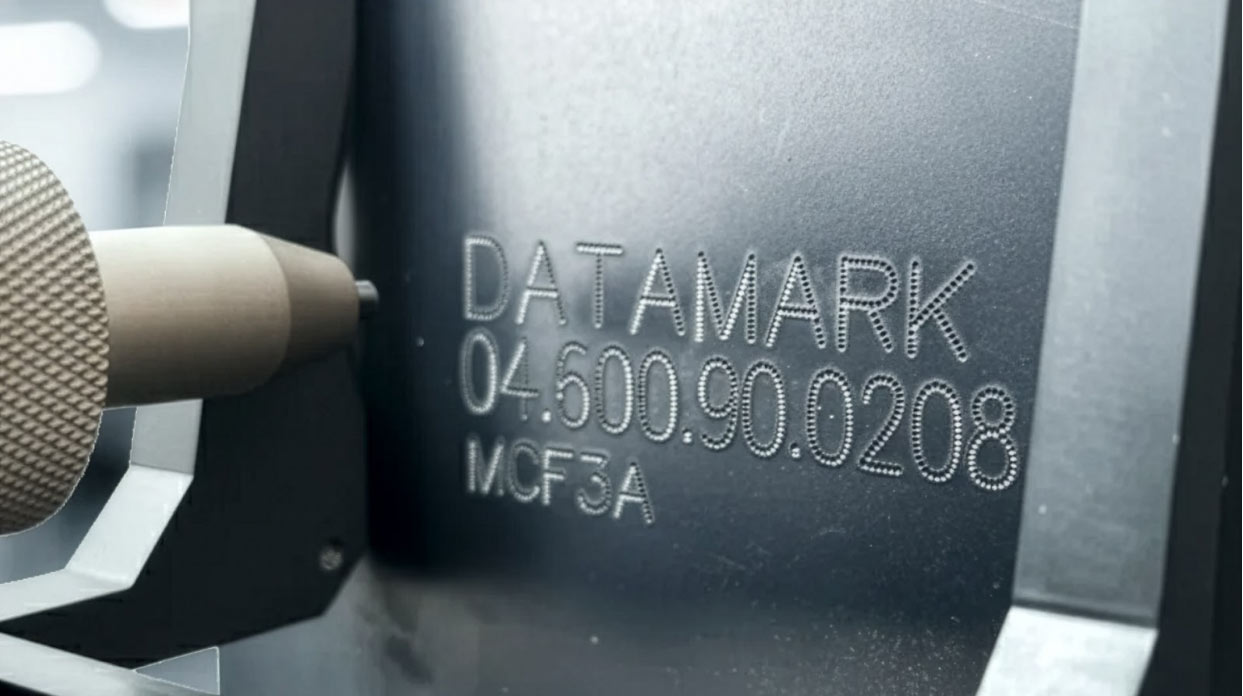
Dot peen marking uses a stylus or pin to create a series of indented dots that form numbers, characters, or 2D Data Matrix codes. It’s a mechanical process commonly used for engine blocks, chassis, and gear components, offering deep, permanent marks that withstand harsh conditions.
Advantages: Durable, low consumable cost, and readable even after coating or painting.
b. Laser Marking
Laser systems use focused beams of light to etch, engrave, or anneal the surface of a material. This method is ideal for high-precision, permanent marking on metals and plastics. It supports intricate codes, logos, and alphanumeric text while maintaining high contrast and readability.
Advantages: Non-contact, permanent, high-speed, and maintenance-free.
c. Inkjet Coding and Marking
Inkjet systems are widely used for temporary or high-speed printing of lot codes and identification numbers. They are suitable for parts that don’t require permanent marks or for secondary packaging identification.
Advantages: Flexible, cost-effective, and easy to integrate with production lines.
d. Electrochemical Etching
This process uses a stencil and electrolyte solution to mark conductive materials. It’s often used for tool marking and low-volume components, offering sharp contrast without affecting material integrity.
Each of these automotive part marking methods serves a specific purpose—laser for longevity, dot peen for toughness, and inkjet for versatility—allowing manufacturers to match the right solution to each application.
Benefits of Laser Marking in the Automotive Industry
Among all marking methods, laser marking has become the industry’s gold standard for reliability, precision, and sustainability.
a. Permanence and Durability
Laser marks are resistant to abrasion, heat, oil, and chemicals—making them ideal for under-the-hood and structural components. They remain legible throughout a vehicle’s lifespan, even in harsh environments.
b. High-Speed, High-Resolution Marking
Modern laser systems can mark at exceptional speeds without compromising accuracy. From small electronic parts to large chassis sections, lasers maintain consistent depth and clarity—even at production speeds exceeding hundreds of parts per minute.
c. Non-Contact and Damage-Free
Unlike mechanical methods, laser marking doesn’t physically impact the material. This prevents distortion, stress, or contamination—particularly important for delicate or coated components.
d. Eco-Friendly Operation
Laser systems require no inks, acids, or solvents, producing zero consumable waste. Their energy-efficient design supports manufacturers’ sustainability goals while reducing operating costs.
e. Data Flexibility
Laser marking seamlessly integrates with MES and ERP systems, enabling variable data printing such as VINs, serial numbers, or QR codes. This allows every component to be uniquely identified and digitally linked to its production data.
For these reasons, laser marking has become synonymous with traceability and quality in the automotive industry.
Ensuring Traceability with Part Marking
Traceability is central to modern automotive manufacturing. A robust automotive part marking system ensures every component can be tracked from its origin to the end of its service life.
a. Production-Level Traceability
Every marked component carries critical manufacturing data—such as supplier information, shift codes, or inspection timestamps. This allows real-time monitoring of process efficiency and immediate identification of defects.
b. Supply Chain Visibility
Unique part identifiers support end-to-end visibility across global supply chains. When a defect or recall occurs, affected batches can be pinpointed quickly, minimizing financial loss and reputational damage.
c. Aftermarket and Service Benefits
Beyond manufacturing, traceable marks assist repair centers and service technicians. They can instantly access part histories, verify authenticity, and ensure replacements match OEM standards.
In short, traceability made possible by automotive part marking not only supports compliance—it also drives better data intelligence, safety, and customer trust.

Understanding Regulations for Part Marking
Compliance with international and regional standards is a critical driver for automotive part marking. Automakers must adhere to various mandates that govern identification, traceability, and labeling.
a. ISO and AIAG Standards
The Automotive Industry Action Group (AIAG) and ISO/TS 16949 outline best practices for traceability, quality management, and part marking data structures. They emphasize permanent, machine-readable identifiers such as Data Matrix codes or VIN serialization.
b. NHTSA and Regional Regulations
In the U.S., the National Highway Traffic Safety Administration (NHTSA) mandates permanent VIN marking and component identification for vehicle tracking and theft prevention. Similar regulations exist in the EU and Asia for parts like airbags, electronics, and emission systems.
c. OEM and Supplier Requirements
Major OEMs impose their own traceability frameworks that suppliers must follow. For example, each supplier component must bear a consistent, scannable identifier compatible with the OEM’s production database.
Failure to comply can lead to penalties, supplier delisting, or recalls—underscoring the importance of reliable, compliant marking systems.
Innovations in Automotive Part Marking Technology
The next generation of automotive part marking is driven by automation, connectivity, and precision. As Industry 4.0 reshapes manufacturing, part marking is becoming smarter, faster, and more sustainable.
a. Smart Laser Systems
Modern laser marking systems feature AI-powered cameras that verify marks in real time. These systems automatically adjust parameters like focus, contrast, or power output based on material or curvature—ensuring optimal mark quality with minimal intervention.
b. Data Integration and Cloud Connectivity
New systems integrate directly with MES, ERP, and cloud platforms, providing real-time analytics for production efficiency and traceability. This connection ensures every mark is logged, verified, and traceable from the factory floor to the end user.
c. Eco-Friendly Lasers and Inks
Manufacturers are adopting fiber and green lasers that consume less energy and last longer than traditional CO₂ systems. Meanwhile, inkjet innovations include low-VOC inks and solvent recycling systems for reduced environmental impact.
d. Automation and Robotics Integration
Collaborative robots (cobots) now handle laser marking tasks, improving safety and consistency. Automated vision inspection verifies mark quality, eliminating human error and ensuring zero-defect manufacturing.
e. Predictive Maintenance and Remote Support
AI algorithms now predict maintenance needs based on laser runtime, temperature, and environmental conditions. This prevents downtime and ensures maximum uptime for critical marking operations.
The evolution of automotive part marking is clear: smarter, greener, and more connected systems are setting new standards for reliability and performance in automotive production.
Conclusion
In an era defined by automation and accountability, automotive part marking has become essential to every manufacturer’s digital strategy. It ensures full traceability, regulatory compliance, and quality control—all while supporting lean and sustainable operations.
From traditional dot peen systems to advanced fiber lasers, marking technology continues to evolve, offering faster speeds, greater precision, and deeper data integration. Manufacturers that invest in modern marking solutions not only protect their brand but also future-proof their operations in an increasingly competitive automotive landscape.
Contact REA JET to explore how agile coding and marking can unlock your packaging potential.